
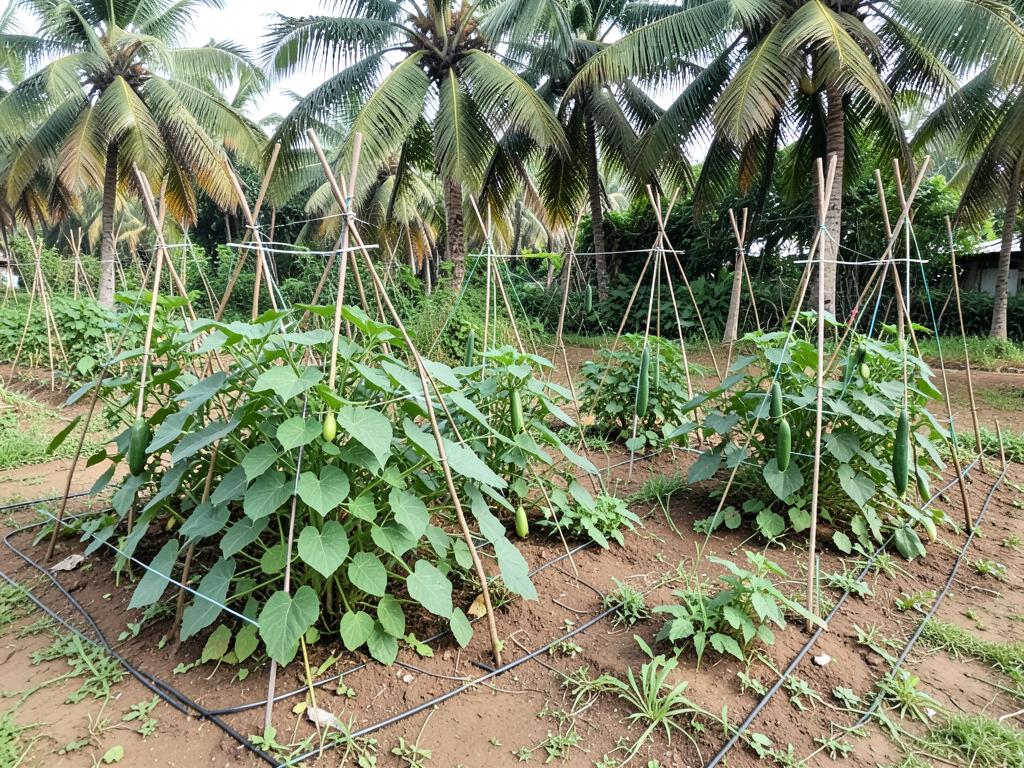
Organic vegetable rotation
Most vegetables sold in Kerala arrive by lorry from Tamil Nadu and Karnataka, days old and rarely organic. A rotation of amaranthus, cowpea, okra and snake gourd turns idle land into a supply of same-week produce, with the first cut in as little as two months and a fresh crop following it. This is the model that feeds our storefront most reliably.
Land needed
0.1 acres+
First harvest
2 months
Indicative yield
4,625 kg/acre
Water need
Moderate
Species covered
4
What gets planted
| Species | Soil pH | Harvest | Yield / acre | Rate |
|---|---|---|---|---|
| Amaranthus | 5.5–7.5 | 2 months | 4,000 kg | ₹40/kg |
| Ladies finger | 6–7.5 | 4 months | 5,000 kg | ₹45/kg |
| Cowpea | 5.5–7.5 | 3 months | 3,500 kg | ₹50/kg |
| Snake gourd | 6–7.5 | 4 months | 6,000 kg | ₹35/kg |
The full crop cycle
Every stage below is tracked in the app: field staff close tasks with photos and a location, and a supervisor approves them before the cycle moves on.
- 1
Land preparation
Month 0–1Clearing, soil testing, ploughing, organic manure and compost application, drip or channel irrigation laid out, GPS pin and photos recorded.
- 2
Planting
Month 1–2Certified planting material set out at recommended spacing by the assigned SHG team, with a photo of every completed block.
- 3
Nursing & feeding
Month 2Weeding, mulching, organic top dressing, staking and irrigation on a fixed task calendar. Each task closes only with proof.
- 4
Pest & disease watch
Month 2–3Weekly scouting with photos. Only organic controls — neem, bio-pesticides, traps. An advisor is consulted for anything unusual.
- 5
Harvest
Month 3–4Graded picking, weight logged batch by batch against the crop cycle, each batch given a QR code that a buyer can trace.
- 6
Sale & settlement
Month 3–4Produce moves to our storefront and procurement buyers. Owner payout, SHG wages and produce credit are settled from the recorded weights.
Project report
Basis: 1 acre · okra, snake gourd & amaranthus · 4-month cycle
Setup cost (one-time)
₹75,000
Running cost / cycle
₹76,000
Expected sales / cycle
₹1,44,000
Farm margin / cycle
₹68,000
Cycles per year
3
After first cycle
−₹7,000
Break-even
Month 6
Sales begin
Month 2
Setup cost
| Land preparation & beds | ₹15,000 |
| Pandal / trellis for gourds | ₹30,000 |
| Drip irrigation | ₹30,000 |
| Total | ₹75,000 |
Running cost per cycle
| Seeds & seedlings | ₹6,000 |
| Organic manure & bio-inputs | ₹15,000 |
| SHG field labour | ₹35,000 |
| Organic pest control | ₹4,000 |
| Harvest & daily transport | ₹8,000 |
| Landowner lease (indicative) | ₹8,000 |
| Total | ₹76,000 |
Expected sales per cycle
| Ladies finger | 1,600 kg × ₹40 | ₹64,000 |
| Snake gourd | 1,500 kg × ₹30 | ₹45,000 |
| Amaranthus | 1,000 kg × ₹35 | ₹35,000 |
Season scenarios (per cycle)
Weak: 25% lower yield and 15% lower price. Good: 10% higher on both.
Weak season
Sales ₹91,800
Margin ₹15,800
Expected
Sales ₹1,44,000
Margin ₹68,000
Good season
Sales ₹1,74,240
Margin ₹98,240
Key success factors
- Three cycles a year keeps cash moving every few weeks.
- Direct sale through our storefront avoids middlemen.
- Crop rotation keeps soil and pests in balance.
Main risks
- Perishable — unsold produce is lost within days.
- Gluts from Tamil Nadu supply depress prices.
Final summary
Fastest cash cycle of all models and the strongest case for local food security. Margins are thinner per cycle but repeat three times a year; reliable daily selling is the key.
What this means for you
For landowners
- Your land stays in your name. We work on it under a written lease or revenue-share agreement with a fixed tenure.
- Three ways to be paid: a fixed monthly lease per acre, a share of revenue, or produce credit you can spend in our store — or a mix.
- We carry the cost of planting material, labour, inputs and irrigation. You are not asked to invest.
- You see stage photos, task completions and harvest weights for your parcel in your dashboard.
- The land is returned cleared and soil-tested at the end of the tenure.
For SHG teams
- An empanelled SHG team is assigned to the parcel and owns the day-to-day field work.
- Work arrives as dated tasks on the phone, with the stage checklist for that crop.
- Every task closes with a photo and a GPS location; a supervisor approves or returns it with a note.
- Payment is per approved task or per stage, settled into the team account with a visible ledger.
- Tasks can be completed offline in the field and sync when the phone finds a network.
For bulk buyers
- Harvest dates are planned in advance, so bulk orders can be booked against a known window.
- Every batch carries a trace code linking it to the parcel, crop cycle and harvest date.
- Grown organically under supervised field records; quality grade is noted at collection.
- Hotels, institutions, retailers and Ayurveda makers can arrange scheduled pickups or delivery.
- Supply depends on weather and season; confirmed quantities are shared closer to harvest.
All figures on this page are indicative planning numbers drawn from our crop catalogue. Actual yield, timing and price depend on soil, weather and market. This is a private venture with no government affiliation, and nothing here is an offer of guaranteed returns.