
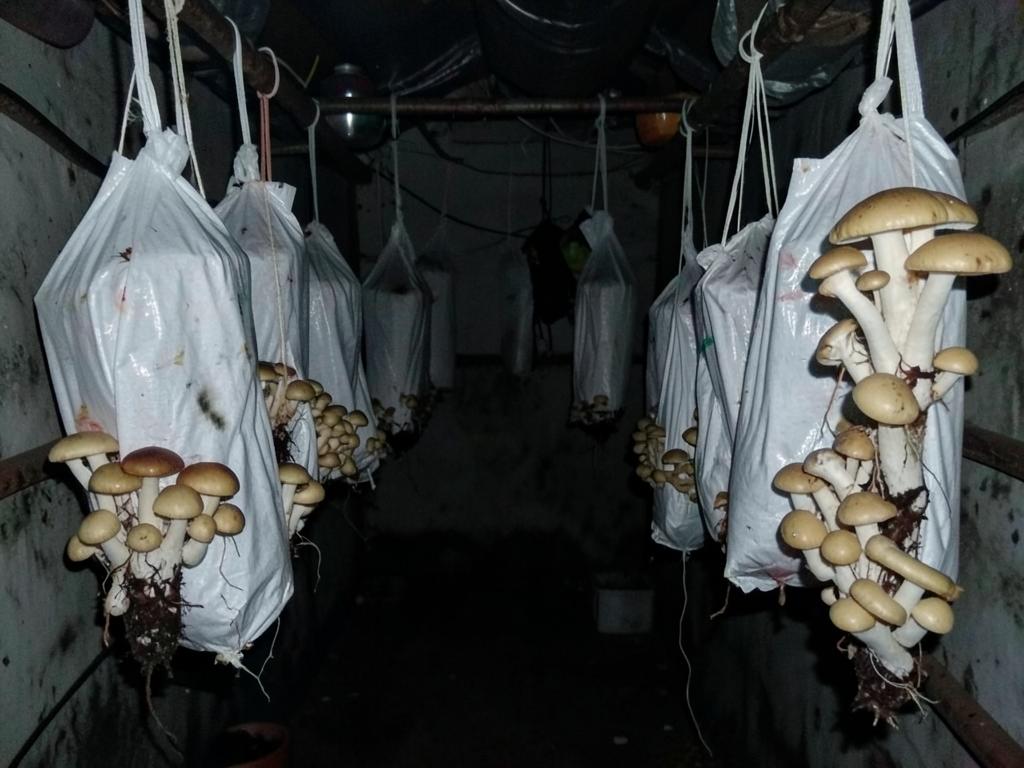
Mushroom growing unit
Mushrooms are grown indoors on straw substrate, so the model needs a dark humid room rather than farmland — a tenth of an acre is enough. Oyster mushroom fruits about two months after spawning and a room can be cropped repeatedly through the year. It is the fastest and smallest way to put idle space and a small team to work.
Land needed
0.05 acres+
First harvest
2 months
Indicative yield
2,500 kg/acre
Water need
Moderate
Indicative setup
₹2,20,000
Species covered
1
What gets planted
| Species | Soil pH | Harvest | Yield / acre | Rate |
|---|---|---|---|---|
| Mushroom farm | 5–8 | 2 months | 2,500 kg | ₹180/kg |
The full crop cycle
Every stage below is tracked in the app: field staff close tasks with photos and a location, and a supervisor approves them before the cycle moves on.
- 1
Room preparation
Month 0–1A dark, ventilated room fitted with racks or hanging lines, humidity control and a clean water point.
- 2
Substrate & spawning
Month 1Paddy straw chopped, soaked and pasteurised, then layered with spawn into bags under strict hygiene.
- 3
Incubation
Month 1–2Bags held dark and warm for two to three weeks while the mycelium runs; contaminated bags removed immediately.
- 4
Fruiting & picking
Month 2–3Bags opened and misted; flushes are picked every few days and weighed batch by batch.
- 5
Same-day sale
Month 2–3Packed and sold the same day through our storefront and local buyers; spent substrate becomes compost.
What this means for you
For landowners
- Needs a room or shed rather than fertile land — an unused outbuilding often qualifies.
- Footprint is tiny, so the rest of the parcel stays free for a crop model.
- Water and power at the site are the real requirements.
For SHG teams
- Light, sheltered, year-round work — well suited to teams who cannot do heavy field labour.
- Hygiene discipline decides the yield; the checklist is strict about it.
- Picking rounds every few days, with weights entered per batch.
- Because cycles are short, a team is paid several times a year.
For investors
- Two-month cycles — the fastest turnover of capital among all our models.
- Setup is a room, racks and humidity control; no land purchase or heavy machinery.
- Rate per kilo is high and demand is steady from retail and restaurants.
- Straw and spawn are the recurring costs and both are locally available.
- Main risks are contamination wiping out a batch and a shelf life measured in days.
All figures on this page are indicative planning numbers drawn from our crop catalogue. Actual yield, timing and price depend on soil, weather and market. This is a private venture with no government affiliation, and nothing here is an offer of guaranteed returns.