
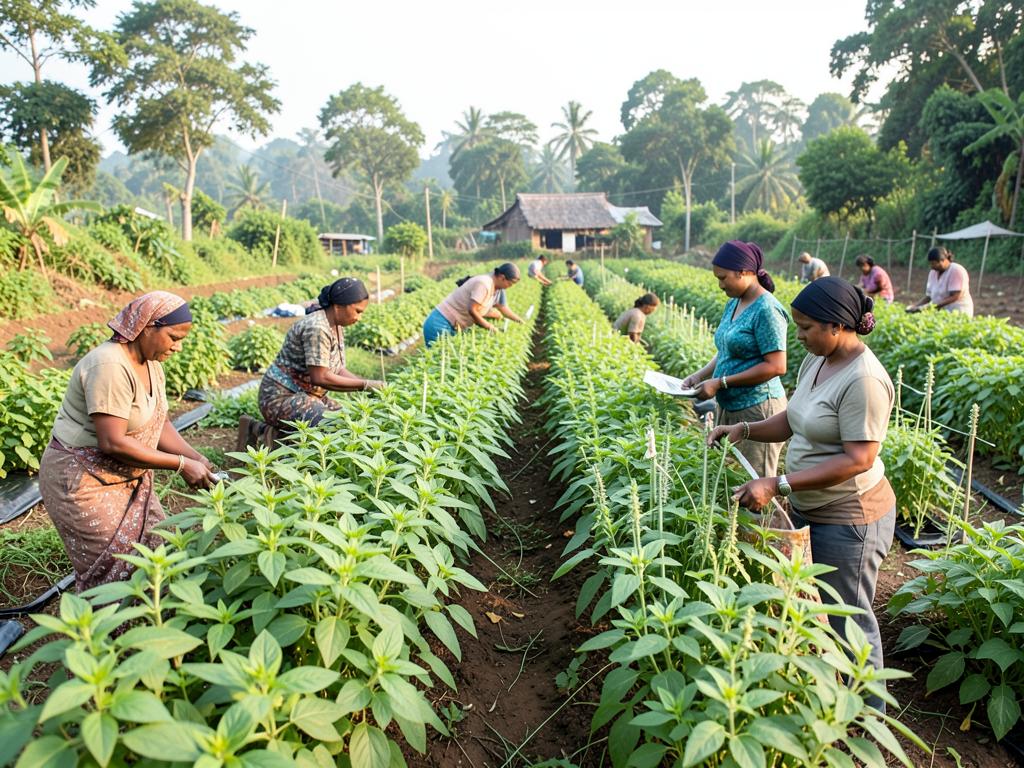
Medicinal plant garden
Kerala's Ayurveda industry buys most of its raw herbs from outside the state. A medicinal garden works on small, dry or partly shaded plots that vegetables would struggle on, and pays per kilo rather than per tonne. Short crops such as brahmi and tulsi come in around four months, while ashwagandha takes about six, so a plot can carry more than one harvest a year.
Land needed
0.1 acres+
First harvest
4 months
Indicative yield
5,767 kg/acre
Water need
High
Species covered
6
What gets planted
| Species | Soil pH | Harvest | Yield / acre | Rate |
|---|---|---|---|---|
| Ashwagandha | 7–8.5 | 6 months | 600 kg | ₹180/kg |
| Brahmi | 6–7.5 | 4 months | 4,000 kg | ₹45/kg |
| Tulsi | 6–7.5 | 4 months | 5,000 kg | ₹30/kg |
| Aloe vera | 6–8 | 10 months | 12,000 kg | ₹12/kg |
| Lemongrass | 5.5–7.5 | 8 months | 10,000 kg | ₹8/kg |
| Kacholam | 5.5–7 | 8 months | 3,000 kg | ₹90/kg |
The full crop cycle
Every stage below is tracked in the app: field staff close tasks with photos and a location, and a supervisor approves them before the cycle moves on.
- 1
Land preparation
Month 0–1Clearing, soil testing, ploughing, organic manure and compost application, drip or channel irrigation laid out, GPS pin and photos recorded.
- 2
Planting
Month 1–2Certified planting material set out at recommended spacing by the assigned SHG team, with a photo of every completed block.
- 3
Nursing & feeding
Month 2Weeding, mulching, organic top dressing, staking and irrigation on a fixed task calendar. Each task closes only with proof.
- 4
Pest & disease watch
Month 2–6Weekly scouting with photos. Only organic controls — neem, bio-pesticides, traps. An advisor is consulted for anything unusual.
- 5
Harvest
Month 6–7Graded picking, weight logged batch by batch against the crop cycle, each batch given a QR code that a buyer can trace.
- 6
Sale & settlement
Month 6–7Produce moves to our storefront and procurement buyers. Owner payout, SHG wages and produce credit are settled from the recorded weights.
What this means for you
For landowners
- Your land stays in your name. We work on it under a written lease or revenue-share agreement with a fixed tenure.
- Three ways to be paid: a fixed monthly lease per acre, a share of revenue, or produce credit you can spend in our store — or a mix.
- We carry the cost of planting material, labour, inputs and irrigation. You are not asked to invest.
- You see stage photos, task completions and harvest weights for your parcel in your dashboard.
- The land is returned cleared and soil-tested at the end of the tenure.
For SHG teams
- An empanelled SHG team is assigned to the parcel and owns the day-to-day field work.
- Work arrives as dated tasks on the phone, with the stage checklist for that crop.
- Every task closes with a photo and a GPS location; a supervisor approves or returns it with a note.
- Payment is per approved task or per stage, settled into the team account with a visible ledger.
- Tasks can be completed offline in the field and sync when the phone finds a network.
For investors
- Short cycles of four to ten months allow more than one turn a year on the same plot.
- Low setup cost per acre — no structures, modest irrigation, mostly labour and planting material.
- Buyers are Ayurveda manufacturers and herbal traders who buy dried, graded material by weight.
- Value per kilo is high, so drying, grading and clean storage matter more than raw volume.
- Main risks are moisture damage during drying and a thinner buyer pool than for vegetables.
All figures on this page are indicative planning numbers drawn from our crop catalogue. Actual yield, timing and price depend on soil, weather and market. This is a private venture with no government affiliation, and nothing here is an offer of guaranteed returns.