
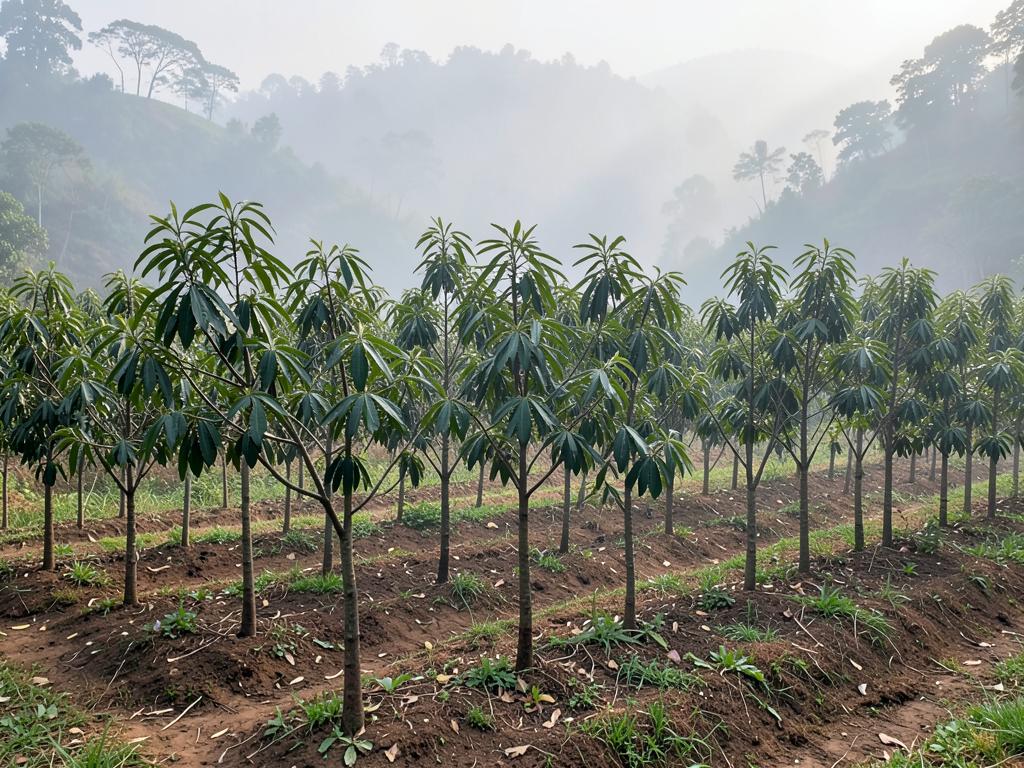
Agarwood & timber plantation
Agarwood, teak and red sanders are long-tenure crops: the trees stand for seven to twelve years and are harvested once, at high value. They suit sloping or remote parcels that cannot support intensive vegetable work, and they need very little attention after the first two years. Because the commitment is long, these run only under a multi-year written agreement — and red sanders additionally requires statutory permission before planting and felling.
Land needed
1 acres+
First harvest
84 months
Indicative yield
833 kg/acre
Water need
Moderate
Indicative setup
₹1,80,000
Species covered
3
What gets planted
| Species | Soil pH | Harvest | Yield / acre | Rate |
|---|---|---|---|---|
| Agarwood | 5.5–7 | 84 months | 500 kg | ₹1800/kg |
| Teak | 6–7.5 | 120 months | 1,200 kg | ₹900/kg |
| Red sanders | 6–8 | 144 months | 800 kg | ₹2200/kg |
The full crop cycle
Every stage below is tracked in the app: field staff close tasks with photos and a location, and a supervisor approves them before the cycle moves on.
- 1
Site survey & agreement
Month 0–2Slope, drainage and soil are surveyed, permits checked where the species needs them, and a long-tenure agreement signed with the landowner.
- 2
Pitting & planting
Month 2–6Pits dug at species spacing, filled with compost, saplings planted and each one fenced or guarded against cattle.
- 3
Establishment care
Month 6–30Two years of weeding, watering in dry spells, gap filling for failed saplings and formative pruning.
- 4
Growth monitoring
Month 30–84Girth and height recorded each year with photographs, boundary and fire protection maintained, and intercropping allowed in the early years.
- 5
Harvest & compliance
Month 84–144Felling or resin extraction is done only after the required permissions, with weights and buyer records against the crop cycle.
What this means for you
For landowners
- This is a multi-year commitment — the agreement runs for the life of the trees, not one season.
- Rent is paid through the waiting years, so the land earns before the trees are cut.
- Short crops can often be grown between the rows during the first two or three years.
- Where the species is regulated, we obtain the permissions and keep the paperwork on file.
- Harvest terms, share and felling responsibility are written into the agreement before planting.
For SHG teams
- Heavy work is concentrated in the first two years — pitting, planting, guarding and weeding.
- After establishment the team handles periodic rounds: measurement, fire lines, fencing repair.
- Tasks and proof photos work exactly as on annual crops, just at a slower rhythm.
- Teams stay paid through the quiet years by taking on intercrops on the same parcel.
For investors
- Single realisation after seven to twelve years — patient capital, not a yearly return.
- Setup cost per acre is high and concentrated in the first two years; upkeep is light after that.
- Value per kilo is the highest of any model we run, which is what carries the long wait.
- Annual girth and height records plus photographs are the only interim evidence of progress.
- Main risks are regulatory delay on restricted species, fire, theft and the sheer length of the horizon.
All figures on this page are indicative planning numbers drawn from our crop catalogue. Actual yield, timing and price depend on soil, weather and market. This is a private venture with no government affiliation, and nothing here is an offer of guaranteed returns.